
Introduction to Our Faith
As a voluntary aided Roman Catholic School, Religious Education is an integral part of our ethos, aims and relationships. We are part of the Archdiocese of Birmingham working closely with the Birmingham Diocesan Education Service
Our faith permeates all aspects of school life. We believe that links between home, school and parish are vital.
Prayer and Liturgy
Our Catholic Faith is central to the day-to-day life of our school and all aspects of the curriculum, and pupils are encouraged to recognise the importance of their faith and they respond to all forms of liturgy and collective worship with respect and reverence.
We have a rich liturgical life in that the experiences we provide are wide ranging and take place in school, out of school, in Church and in the wider community, and engage and involve pupils, parents, staff, governors and the parish.
The Celebration of the Eucharist and prayer are central in our school.
Our Parish Priest regularly celebrates Mass for us. Each class takes on the responsibility of planning their own celebration of the Mass. In addition, we celebrate special Whole School Masses at the beginning and end of term, our school feast day, holy days of obligation and other significant occasions.
All acts of worship have a liturgical structure and are thoroughly planned and delivered.
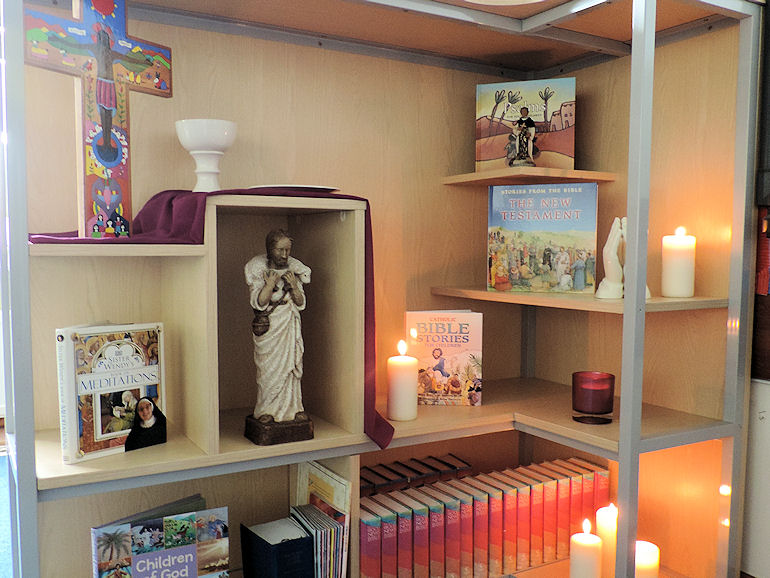
One of our RE focus areas, which reflects our faith
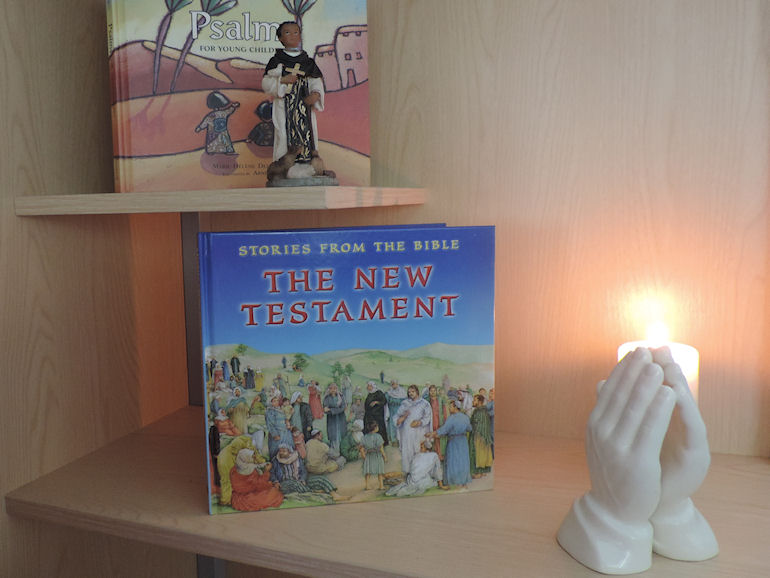
Prayer is central to all that we do in school
Religious Education – Discerning Disciples
Our Religious Education is at the centre of our curriculum and is the core of the core of our curriculum.
Following the introduction of the Religious Education Directory (RED) ‘To know you more clearly’ in September 2026, we follow the Archdiocese of Birmingham’s ‘Discerning Disciples’.
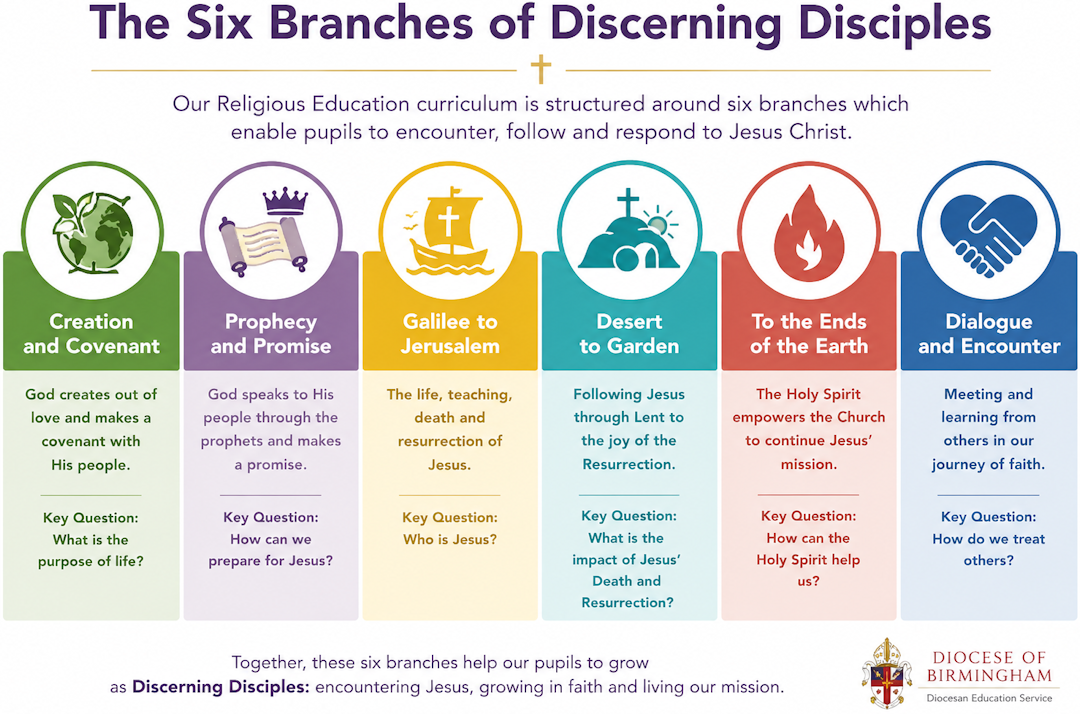
Six Curriculum Branches
The Religious Education curriculum is structured according to the six curriculum branches set out in the RED. Each branch is studied sequentially each year and revisited with increasing depth and challenge.
The Six Branches include:
- Creation and Covenant
- Prophecy and Promise
- Galilee to Jerusalem
- Desert to Garden
- To the Ends of the Earth
- Dialogue and Encounter
Knowledge Lenses
Teaching and learning within each branch is framed through the following lenses:
- Hear – encountering Scripture and Church teaching
- Believe – understanding what the Church teaches and believes
- Celebrate – exploring prayer, liturgy and sacramental life
- Live – applying faith to everyday life Ways of Knowing Pupils are supported to:
- Understand – develop secure knowledge and meaning
- Discern – think critically and reflectively
- Respond – make informed, personal and moral responses
Lesson Structure
All Religious Education lessons will follow the structure as advised by the Birmingham Diocesan Education Service:
- Dialogue – from the beginning and throughout the lesson. Unlock pupils’ prior knowledge through discussion.
- Introduce recall – I do. Introduce the Direct Knowledge Statements relevant to the lesson.
- Scaffold Support – Teacher to model and design and remove scaffold so all pupils move from secure knowledge to meaningful discernment.
- Collaborative Conversation – We do. Pupils discuss discovery questions with teacher guidance.
- Evaluate understanding – Teachers use hinge questions to assess the understanding of all pupils before moving on.
- Record responses with discernment – You do. Pupils independently record their understanding and response.
- Next steps and notes – Use age-appropriate reflection and feedback to evaluate learning and inform next steps.
See our RE Long Term Plan and Statement of Intent on our Curriculum Introduction page for details of how we teach RE across the school.